본문으로 건너뛰기
← Back to Blog
건강

10-Minute Daily Neck Posture Correction Stretches — An Essential Routine for Office Workers

공유

Spending long hours sitting at a computer or using a smartphone often leads to your neck and shoulders leaning forward. If, when looking at your profile in the mirror, your ears are positioned in front of your shoulders, you may already be experiencing Forward Head Posture, commonly known as "tech neck." According to research from Harvard Medical School, for every 2.5 cm (about 1 inch) your head moves forward, the load on your cervical spine increases by approximately 4–5 kg (9–11 lbs). Here, we've summarized an effective 10-minute routine with eight proven exercises to help reduce this strain.

The Real Problems Caused by Forward Head Posture

Forward head posture isn't just about looking slouched or unconfident. When your cervical alignment breaks down, a chain reaction of issues can occur:

  • Chronic headaches and migraines: Constant tension in the suboccipital muscles reduces blood flow to the head.
  • Shoulder and arm numbness: Compression of cervical nerve roots (C5–C7) can dull sensation down your arms and hands.
  • Reduced focus and poor sleep quality: Overly tense neck muscles keep your sympathetic nervous system in a heightened state, making restorative sleep harder to achieve.
  • Shallow breathing: A closed chest limits diaphragm movement, reducing the amount of oxygen you take in with each breath.
  • Fortunately, most cases of forward head posture can be reversed by combining three strategies: strengthening the deep cervical flexors, stretching shortened muscles at the front, and activating postural muscles at the back. The routine below covers all three components.
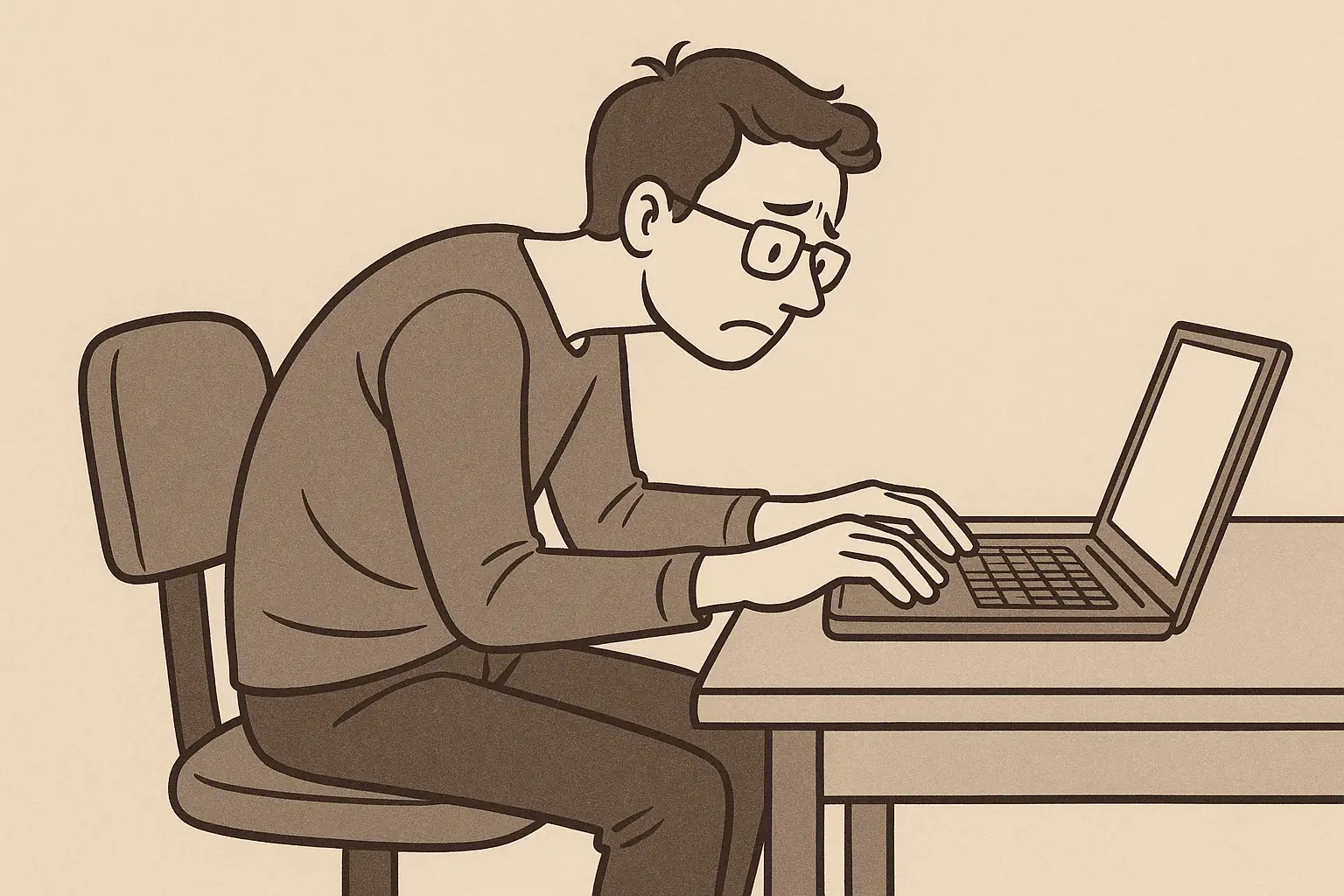
    Incorrect desk posture and the beginning of tech neck in office workers
    Incorrect desk posture and the beginning of tech neck in office workers

    The Complete 10-Minute Correction Routine — 8 Proven Exercises

    1. Chin Tuck — 1 minute 30 seconds

    This is the cornerstone of neck posture correction. Almost every physical therapy program starts with this movement to activate the deep cervical flexors.

  • Sit or stand with your spine straight.
  • Keeping your eyes forward, gently draw your chin straight back, as if making a double chin. Do not tilt your head down.
  • Hold for 5 seconds, then relax. Repeat 10 times for 2 sets.
  • > Tip: Place your fingers on your chin and gently push back to get a feel for the movement. This can be done anytime at your desk.

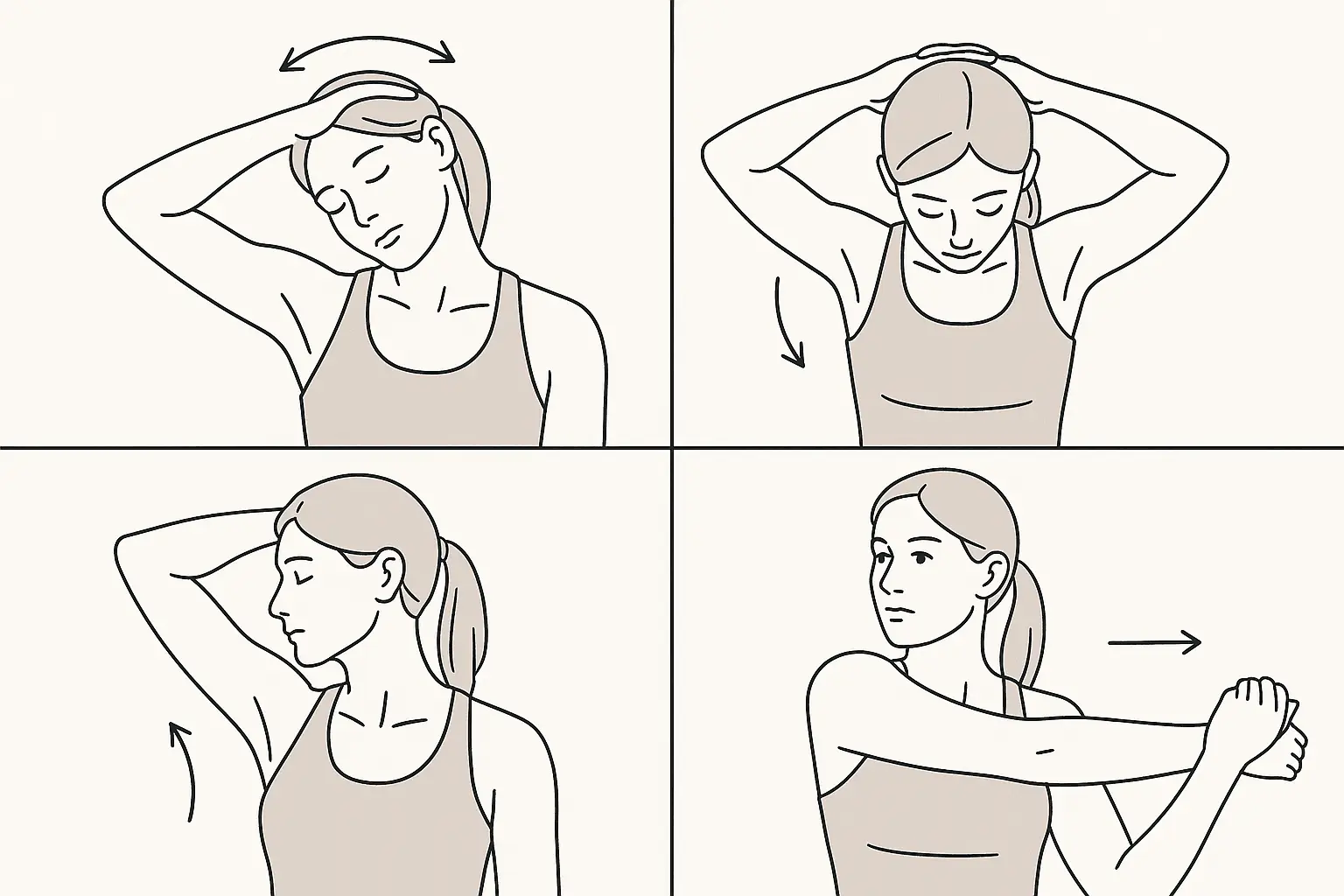
    2. Upper Trapezius Stretch — 40 seconds each side

    This stretch releases tension in the upper trapezius, which runs from your shoulders to your neck.

  • Raise your right hand over your head and place it near your left ear.
  • Gently pull your head to the right while lowering your right shoulder toward the floor.
  • Make sure your opposite shoulder doesn't rise. Hold for 20 seconds, 2 sets per side.
  • 3. Levator Scapulae Stretch — 40 seconds each side

    The levator scapulae connects your shoulder to your neck and is often tight in people who use a mouse or keyboard for long periods.

  • Use your right hand to press down on your right shoulder and keep it in place.
  • Tuck your chin toward your chest, then tilt your head down and to the left at a 45-degree angle, as if looking toward your left armpit.
  • You should feel a stretch at the back of your right shoulder. Hold for 20 seconds, 2 sets per side.
  • 4. Doorway Pec Stretch — 1 minute

    People with forward head posture almost always have shortened chest muscles (pectoralis major and minor), which pull the shoulders forward.

  • Stand in a doorway and raise your arms into an L-shape, placing your elbows and palms on the door frame.
  • Step one foot forward and gently press your chest forward.
  • Hold for 20 seconds at the point where you feel a stretch across your chest, 3 sets. Change your elbow angle to 90, 120, and 150 degrees to stretch the entire chest area.
  • 5. Thoracic Extension — 1 minute

    A hidden cause of tech neck is stiffness in the thoracic spine (upper back). When your upper back rounds, your neck naturally juts forward.

  • Sit in a chair and lace your fingers behind your head.
  • As you exhale, open your chest toward the ceiling and arch your upper back over the backrest.
  • The key is to move only your upper back, not your head. Repeat 10 times for 2 sets.
  • > Tip: If you have a foam roller, try lying on it horizontally just below your shoulder blades for an even greater effect.

    6. Wall Angel — 1 minute

    This exercise helps restore your shoulder blades to their proper position and activates postural muscles.

  • Stand with your back against a wall, making sure your heels, hips, back, and head all touch the wall.
  • Bend your arms into an L-shape and place the backs of your hands against the wall.
  • Slowly raise and lower your arms, keeping the backs of your hands in contact with the wall. Repeat 10 times for 2 sets.
  • If your hands come off the wall at first, it means your thoracic spine and shoulders are quite stiff. Don't force it; just work within your range and you'll improve over time.

    7. Prone Y-T-W Lifts — 8 reps each

    This exercise activates the postural muscles at your upper back (middle/lower trapezius and rhomboids), which are often weakened by desk work.

  • Lie face down with your forehead lightly touching the floor.
  • Y: Raise your arms diagonally overhead with thumbs pointing up, forming a Y shape. 8 reps.
  • T: Extend your arms straight out to the sides, squeezing your shoulder blades together. 8 reps.
  • W: Bend your elbows to 90 degrees, forming a W shape, and squeeze your shoulder blades. 8 reps.
  • All you need is a yoga mat at home. If you're at the office, add this to your evening routine after work.

    8. Cat-Cow Pose — 1 minute

    This finishing exercise restores mobility throughout your entire spine.
  • From a tabletop position, inhale as you drop your belly and look up (Cow Pose).
  • Exhale as you round your back and tuck your chin toward your chest (Cat Pose).
  • Repeat slowly 10 times, focusing on moving each segment of your spine.
  • Proven routine for correcting forward head posture
    Proven routine for correcting forward head posture

    When and How to Practice This Routine

    You can do all 10 minutes at once, but splitting it into three sessions throughout the day can provide even better results:

  • Morning (3 minutes, right after waking up): Chin Tuck, Thoracic Extension, Cat-Cow. This wake-up routine helps loosen your spine after a night's sleep.
  • During work (4 minutes, before lunch and at 3 PM): Upper Trapezius Stretch, Levator Scapulae Stretch, Doorway Pec Stretch. These help release muscles tightened from sitting at your desk.
  • Evening (3 minutes, after work or before bed): Wall Angel, Prone Y-T-W Lifts. This session builds endurance in your postural muscles.
  • Stretching Alone Isn't Enough — 5 Everyday Habits

    No matter how well you exercise, spending 10 hours a day in poor posture will undermine your efforts. Follow these five habits to maximize your results:

  • Monitor height: Adjust your screen so your eyes are 5–10 cm (2–4 inches) below the top edge. Use a laptop stand and external keyboard if needed.
  • Smartphone use: Hold your phone at eye level instead of bending your neck down. It may feel awkward at first, but after a week you'll notice less neck fatigue.
  • 50-10 rule: Every 50 minutes, stand up, walk for 2 minutes, and do a quick set of Chin Tucks, Doorway Pec Stretch, and Thoracic Extension. Set a timer to remind yourself.
  • Pillow: A pillow that's too high bends your neck forward while you sleep. When sleeping on your side, use a pillow as thick as your shoulder; when on your back, about the height of one and a half fists is ideal.
  • Bags: Carrying a heavy bag on one shoulder overdevelops one side of your upper trapezius. Backpacks or crossbody bags are better choices.
  • Increasing your daily movement will also help reduce your overall sitting time. For more, see: The Science of Walking — The Real Impact of 7,000 Steps a Day on Your Health.

    How Long Until You See Results?

    According to studies frequently cited in physical therapy, practicing this routine consistently for 8–12 weeks leads to significant improvements in the craniovertebral angle (a key measure of neck posture). Many people notice reduced pain as early as 2–3 weeks. The key is not intensity, but frequency.

    Final Thoughts

    Forward head posture doesn't develop overnight, so it won't disappear overnight either. But 10 minutes of consistent effort every day will pay off. Set a timer and start with the Chin Tuck today. In just two weeks, you'll likely see a difference in your profile in the mirror.

    For more wellness insights and practical health tips, subscribe to our newsletter.

    10-Minute Daily Neck Posture Correction Stretches — Essentia | 보통리