Can't Go Fully Vegetarian?
A little while ago I had a dream. Living creatures were being prepared as food.
What I remember most is their eyes. They were curious. I was looking into those eyes when I woke up crying.
There was one more strange detail in the dream. A small sign that said "eco-friendly" sat on the table, and right next to it, meat was piled high.
The contradiction and the sadness stayed with me long after I woke up. So I decided to change what goes on my table.
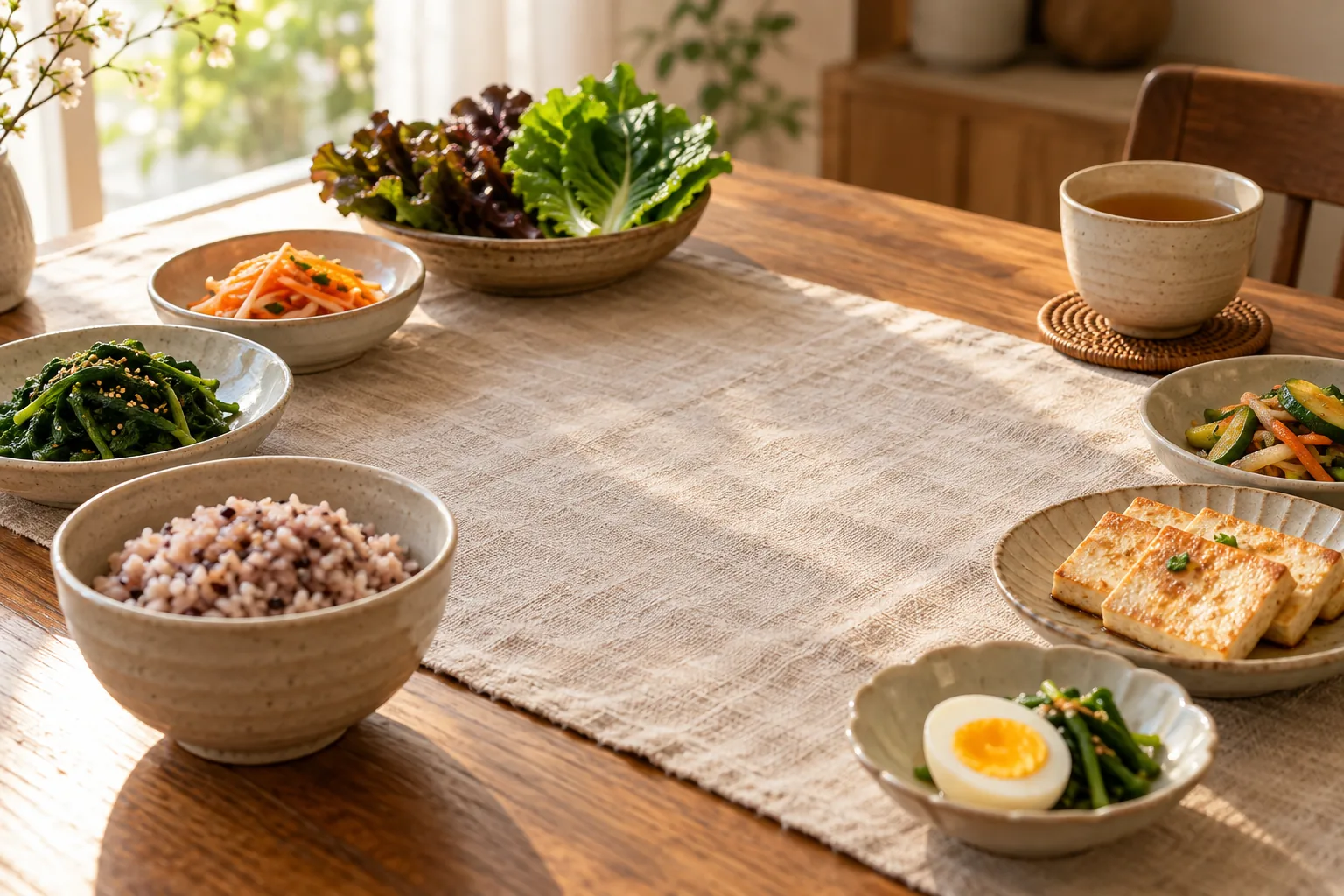
I already knew it in my head
The meat on our plates was once a living being. Nobody is unaware of this. I knew it too. But knowing it had never changed what I actually ate.
What was different this time was the order of things. My head did not reach a conclusion first. My heart cried first. I learned, in my body rather than in theory, that when the heart moves before the head, the direction of a life can change.
The detail that stayed with me was that little sign. You can put the word "eco-friendly" next to something, and it does not change the fact that what is piled beside it was once alive. Looking past the label to what is actually there: to me, that kind of seeing is where compassion begins. Realizing that the meat on the table was once a living creature is a small version of it.
I once said this in a meditation talk. Most people think of meditation as a way to feel calm. But its deeper meaning is that, in the process of coming to know yourself, you start to feel that everything is connected, and you slowly become someone who can hold a much bigger kind of love. And the dreams, the vision, and above all the actions of a person like that matter far more than the calm.
When I met my own soul in meditation, I felt that the compassion the Buddha spoke of was not somewhere outside me. It was already inside. I have also said in a talk that this is the place from which we need to build a future where we live alongside every other living thing on this planet. Whether those words had actually reached the table I set every day is something I only began to look at after that dream.
I tried going fully plant-based once before
This is not my first attempt. Some time ago I ate a fully plant-based diet for a while. It did not last.
The reason had less to do with willpower than with my surroundings. In Korea, there were very few places where I could simply buy a meal outside. Vegan restaurants were far away and expensive. Even dishes with no visible meat often have animal ingredients in the broth or the seasoning: a lot of Korean cooking starts from meat or anchovy stock, and many kimchis and sauces use salted seafood. When every ordinary meal becomes something you have to travel for and pay extra for, it is hard to keep going, no matter how much you mean it.
Traveling in the United States, where vegetarian eating is an established part of everyday food culture, I felt that difference very strongly. The same decision can be easy or nearly impossible to keep, depending on whether your surroundings support it.
If you have tried and quit before, it is worth asking honestly whether it was really your resolve that failed, or whether you were trying to hold a strict rule in a place that made it very costly.
This time I didn't make it all or nothing
So this time I did not set a fully plant-based diet as the goal. I decided on three things instead.
If you want a label, this is close to what people call a flexitarian diet. It may look looser than going fully vegan. For me it is not a retreat. It is a choice made so that it can last.
It does not have to be perfect. I believe that a small adjustment, simply moving meat out of the starring role on the table, is a realistic way of living with more care for other lives and for the environment.
Vegetarian is a spectrum, not a switch
If you once tried a strict plant-based diet and then dropped it, part of the problem may have been treating it as a yes-or-no question. In practice, vegetarian diets are usually described by what they still include.
Which one fits depends on the person and on where they live. Someone who eats out most days and someone who cooks at home most nights cannot start from the same place. Starting where you can actually stay is better than starting high and giving the whole thing up.
What it means to take meat off center stage
I use the phrase "center stage" for a reason. A lot of home meals are built around one meat dish, with everything else arranged around it as a side. That is why a table without meat can feel empty. If you want to eat less meat, it is usually easier to fill the center with something else than to sit there resisting what is missing.
A few ways to try it:
A one-minute pause before you eat
Alongside changing the table, there is one more thing worth trying: a very short pause before you eat. One minute is enough.
You can do this on days when you eat meat as well. The point of the pause is not blame. It is to eat knowingly and with gratitude. This is not a practice of sorting food into good and bad, or of building guilt.
This is not about blaming anyone
I am not writing this to blame people who eat meat. I have not quit it completely myself. This is simply about moving meat to a different place on the table.
Most of us already know a great deal in our heads. It seems that for any of it to reach the dinner table, the heart has to move at least once. For me, it was a dream. For someone else, it might be one quiet minute before a meal.
When you change your diet significantly, the nutrients you need to watch can differ depending on your health, so if you have a medical condition or are in a period where nutrition needs extra care, talk to your doctor first.
In short
If the pause before eating is hard to keep on your own, short guided meditations, starting at five minutes, are on WECOSMO. And if you have ever felt that nothing quite fills the gap no matter how much you add, I wrote about that in why nothing ever feels like enough.
Services by Botonglee