Eyes-Open Meditation: Is Gazing at Water Meditation? What a Garden Mist Taught Me
This happened in a garden in early September.
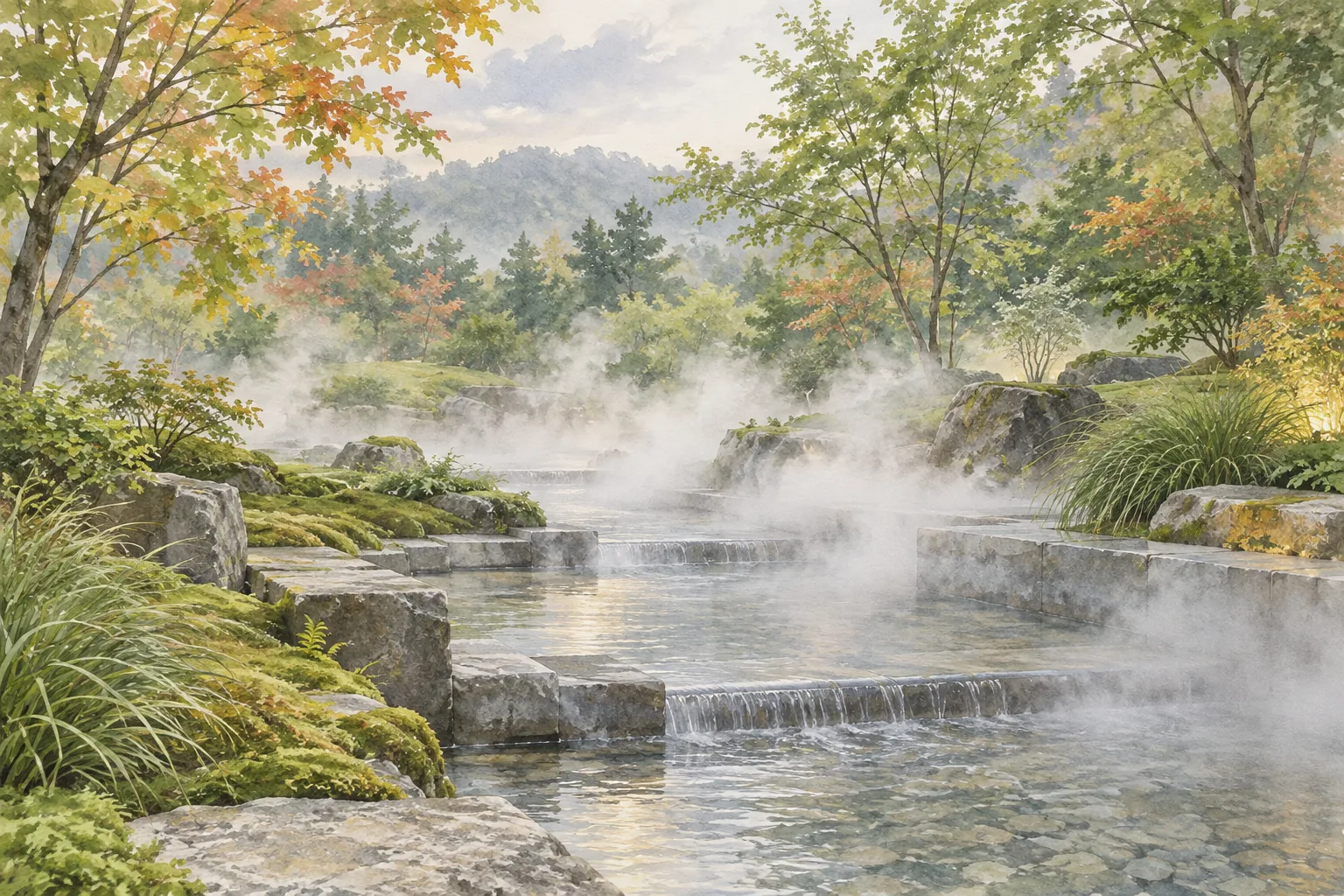
Water ran through the middle of the garden, and above it a mist fountain sent up fog that rose and drifted like small clouds. I stood in front of it for a while and did nothing at all. I only watched the mist move.
I wasn't sitting down. My eyes weren't closed. I wasn't trying to do anything. And yet at some point I found myself in the same state I reach when I meditate looking up at the clouds.
Meditation doesn't start with a posture
Ask most people to picture meditation and you get the same image: legs folded on the floor, back straight, eyes closed, mind empty.
So I often hear some version of this: "When I sit, my legs go numb. When I close my eyes, my head fills up with thoughts. I don't think meditation is for me."
When I begin guiding a meditation, there is a line I often open with:
"Whether your eyes are open or closed, you look at yourself with the eye of your mind, with your awareness, as if you were observing. The heart of meditation is observation."
Sitting, closing your eyes, working with the breath — these are conditions that make watching easier. They are not meditation itself. That afternoon in the garden reminded me of this, because none of the usual conditions were there. I was standing. My eyes were open. I hadn't prepared anything. But the watching was there.
Zoning out vs. meditating: what's the difference?
In Korea there is a popular word, mulmeong — roughly "water-zoning." Its sibling is bulmeong, "fire-zoning." It means staring blankly at running water or a crackling campfire until your head feels rested. And there is a reason it feels good.
Things that move slowly — water, flames, clouds, leaves in the wind — hold your eyes without any effort on your part. At work we spend the whole day using a gripping kind of attention. We read email, scan screens, and hold on tight so we don't miss anything. In front of something slow-moving, that grip can loosen for a while. That's why people say they feel refreshed after a stretch of water-gazing.
So is gazing at water the same as meditating? As I see it, there is exactly one difference.
When you zone out, you drift away into thought before you notice. You were looking at the river, and the next moment you're thinking about tomorrow's to-do list or something someone said yesterday. During that time the river disappeared.
Meditation is watching with the knowing included — the quiet awareness that "I am looking right now." It isn't that no thoughts arise. When a thought comes up, you notice it — "ah, this thought is coming up" — and you come back to the water, to the mist. You watch your thoughts drift past the way you might watch a stranger walk by.
That means turning water-gazing into meditation takes only one thing: knowing that you are looking. And when you've drifted off, knowing that you drifted, and coming back.
Why the mist worked: how to choose a slow object
This is what stayed with me from the garden: meditation doesn't begin with a posture. All it needs is one slow object that the mind can rest on and let go of, and it can open anywhere in ordinary life. When you choose that object, look for four things.
It's slow. Slow enough for your eyes to follow. A phone screen changes so fast it drags your eyes around. The mist was slow enough that my eyes could arrive first and wait for it.
It keeps changing, but never repeats exactly. Mist, clouds, ripples, a candle flame, leaves — none of them holds the same shape for even a moment. That keeps boredom from pulling your eyes away.
It has no story. Faces, words and video scenes invite interpretation. Why is that person frowning? What does that sentence mean? Mist gives you nothing to interpret. It rises and it scatters, and that's all.
You can hold it or let it go. You can rest your gaze on it, and if your mind wanders off, nothing happens. There's nothing to answer and nothing to react to. When you come back, it is still there. That is what makes it a place to return to.
By these standards you don't need a garden. A tree outside your window works. So do clouds, a glass of water settling after you pour it, or steam rising from a humidifier on your desk.
A three-minute eyes-open practice
If sitting still with your eyes closed has never worked for you, start here. You can stand or sit in a chair — either is fine.
If you feel dizzy or uneasy, stop right there and look around the room. If three minutes feels long, one minute is fine.
When you simply watch, stillness comes on its own
There is a line I use at the end of guided meditations: "When you simply watch, you grow still on your own."
What happened in that garden was exactly that. I wasn't trying to become calm. I was only watching the mist, and the stillness came.
You don't need to go looking for the perfect place to meditate. One slow thing, and a mind that knows it is watching, are enough. If seated meditation keeps turning into a report card for you, you may also find this piece helpful: Meditation Is Not Emptying the Mind.
If you'd like to keep practicing at home, WECOSMO has short guided meditations you can follow along with. You can start at wecosmo.space.
Services by Botonglee