No Time to Exercise? Build a Week in Five-Minute Blocks
When you decide to exercise again, the calendar can become the first obstacle. You look for an uninterrupted thirty-minute window between work, errands, household tasks, and family plans. If it never appears, today gets labeled as another day when exercise was impossible.
The missing resource may not be motivation. It may be the size of the time block you are willing to count as movement. If exercise requires special clothes, a separate place, and one complete session, a small disruption can erase the plan.
This is a way to create five-minute movement opportunities in the morning, at midday, and in the evening, then let those pieces accumulate across a week. The shift is simple: a short block becomes a real unit of the plan rather than a consolation prize.
Go to guideRead more practical wellness essaysExplore other ways to care for your body without turning daily life into another performance test.Waiting for thirty free minutes reduces the number of days you can move
When a workout must last at least thirty minutes, planning begins with a long calculation. Add time to change, travel, shower, and gather what you need, and the calendar may require a gap closer to an hour. On a busy weekday, that gap rarely arrives by itself.
A meeting runs late, an errand expands, or someone needs you at home. Exercise is pushed aside, followed by the thought that you will restart when you can do it properly. The problem is not laziness; the doorway is too narrow for ordinary life.
Redesign the doorway before raising the goal. Instead of securing a long empty block, attach a small amount of movement to scenes already in your day. Start with a unit that can survive a real schedule.
Five minutes can count toward a week of activity
Public activity guidance commonly gives adults a weekly target of at least 150 minutes of moderate aerobic activity plus muscle-strengthening activity on two days. That is a total accumulated across a week, not a command to perform the same perfect session every day. Building gradually is more realistic than trying to complete the full target immediately.
Older advice was often interpreted to mean that activity had to continue for a minimum number of minutes before it counted. Current guidance no longer requires that minimum bout. A short walk, a few flights of stairs, or several minutes of strength work can become part of your accumulated movement.
Five minutes is not a ceiling. It is a workable starting unit that can grow to eight or twelve minutes when your body and schedule allow. It turns a vague intention into a completed action and leaves a clear place to return tomorrow.
Create one movement opportunity in the morning, at midday, and in the evening
“I will exercise when I have time” has no visible starting point. Place movement after something that already happens, such as brushing your teeth, finishing lunch, or closing your laptop. The existing action becomes the cue.

In the morning, try five minutes of marching in place and comfortable joint movements before coffee. At midday, walk a little faster around the building after lunch. In the evening, follow closing the laptop with chair sit-to-stands, wall push-ups, and calf raises.
Choose one opportunity as the default and treat the other two as optional. Missing the morning block does not turn the entire day into a loss. A precise cue—“immediately after I return my lunch tray”—also works better than “sometime this afternoon.”
Give each five-minute block only one job
A short block becomes complicated when it tries to contain stretching, cardio, strength, and posture work. Give it one job instead. Choose brisk movement, lower-body strength, upper-body strength, or comfortable mobility.
Monday morning can be a gentle wake-up block, lunch can be brisk walking, and evening can be chair-supported leg work. The next day can include stairs, wall push-ups, and easy shoulder movements. You do not need every category in every block; let aerobic and strength work both appear across the week.
If you have been mostly inactive, begin with a manageable pace and range. Once a block feels steady, change one variable—repetitions, speed, range, or duration—so you can notice how your body responds. Keep a menu of three familiar options to reduce daily decisions.
Read the weekly map instead of grading each day
When movement is judged only as a daily streak, one empty day feels too important. You can complete three blocks on Monday and still believe the plan is broken because Tuesday was crowded. A weekly goal gives you a more useful unit: the pattern, not one square on the calendar.
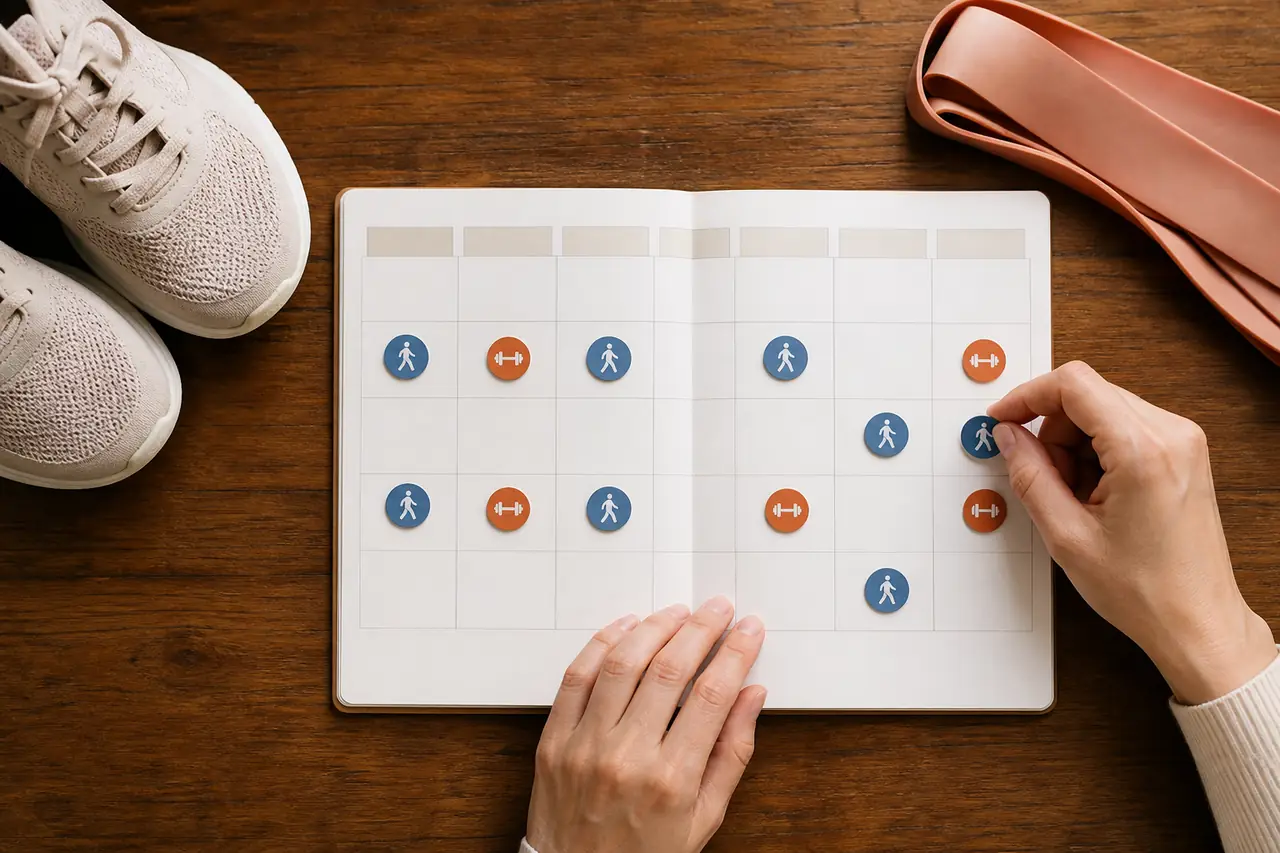
Mark aerobic movement in one color and strength work in another, then fill one small square for each block. At the end of the week, look for where movement started most reliably rather than scolding yourself for empty spaces.
Ask whether both aerobic and strength work appeared, whether an overly demanding day affected the next one, and which cue opened the door most consistently. Keep the cue that worked and adjust only one difficult block. The map is an instrument for learning, not a scorecard.
Plan minimum, standard, and spacious versions
A plan that assumes the same energy every day will struggle during a demanding week. Prepare three versions: minimum, standard, and spacious. Choose the version that fits your body and schedule instead of canceling movement altogether.
The minimum is one five-minute block. The standard may be two or three small blocks, or one session of ten to fifteen minutes. The spacious version can be a longer walk, a class, a bike ride, or another activity you have room to enjoy.
Rest belongs in the system too. Do not force even the minimum through fever, illness, unusual pain, or dizziness. Stop if movement brings chest pain, a feeling that you may faint, or severe shortness of breath, and seek appropriate help.
Try a seven-day movement experiment
On day one, choose one cue and one action: “After lunch, walk for five minutes.” On days two and three, keep the same cue. Add two or three minutes only if it feels easy; if you keep missing it, make the cue more precise instead of increasing the workout.
On day four, add a block with a different job. If you have been walking, try chair sit-to-stands or wall push-ups. On day five, either block is enough, and you can combine them only if your body and schedule feel open.
During the weekend, do not repay every empty weekday with one exhausting session. Choose movement you enjoy, such as walking, cycling, dancing, or active household work. On Sunday, note the cue that worked, the block that created too much resistance, and one action worth carrying forward.
A structure you can restart matters more than one impressive workout
Regular movement grows from a structure that is easy to re-enter. Keep walking shoes visible, reduce your five-minute menu to three known options, and replace a cue that repeatedly fails. Preparation and fewer decisions are part of the plan.
You do not have to treat 150 minutes as a debt due immediately. Make one five-minute square possible today, then notice where those squares accumulate by the end of the week. The first change is learning to find a place for movement inside the day that actually happened.
Services by Botonglee