Prenatal Meditation, Sitting Down: What Pregnancy Taught Me About the Shaking Practice
There is a line I say in almost every class I teach: "Meditation isn't only about sitting still." In the Korean tradition I practice, we wake the body first. We shake, we tap, we move until the energy is flowing, and only then do we sit. I have told students for years that the harder you work the body at the start, the deeper you go afterward, and that the fastest way to wake up your energy is to put vibration straight into the body.
Right now I am pregnant, and I can't do the vigorous whole-body shaking that I have recommended to so many people. Not long ago I joined a practice session and sat through the shaking part instead. This post is about what happened. I'm writing it for anyone who wants to keep practicing through pregnancy, for expecting mothers looking for a prenatal meditation they can actually do, and for anyone whose body, for whatever reason, can't make big movements for a while.
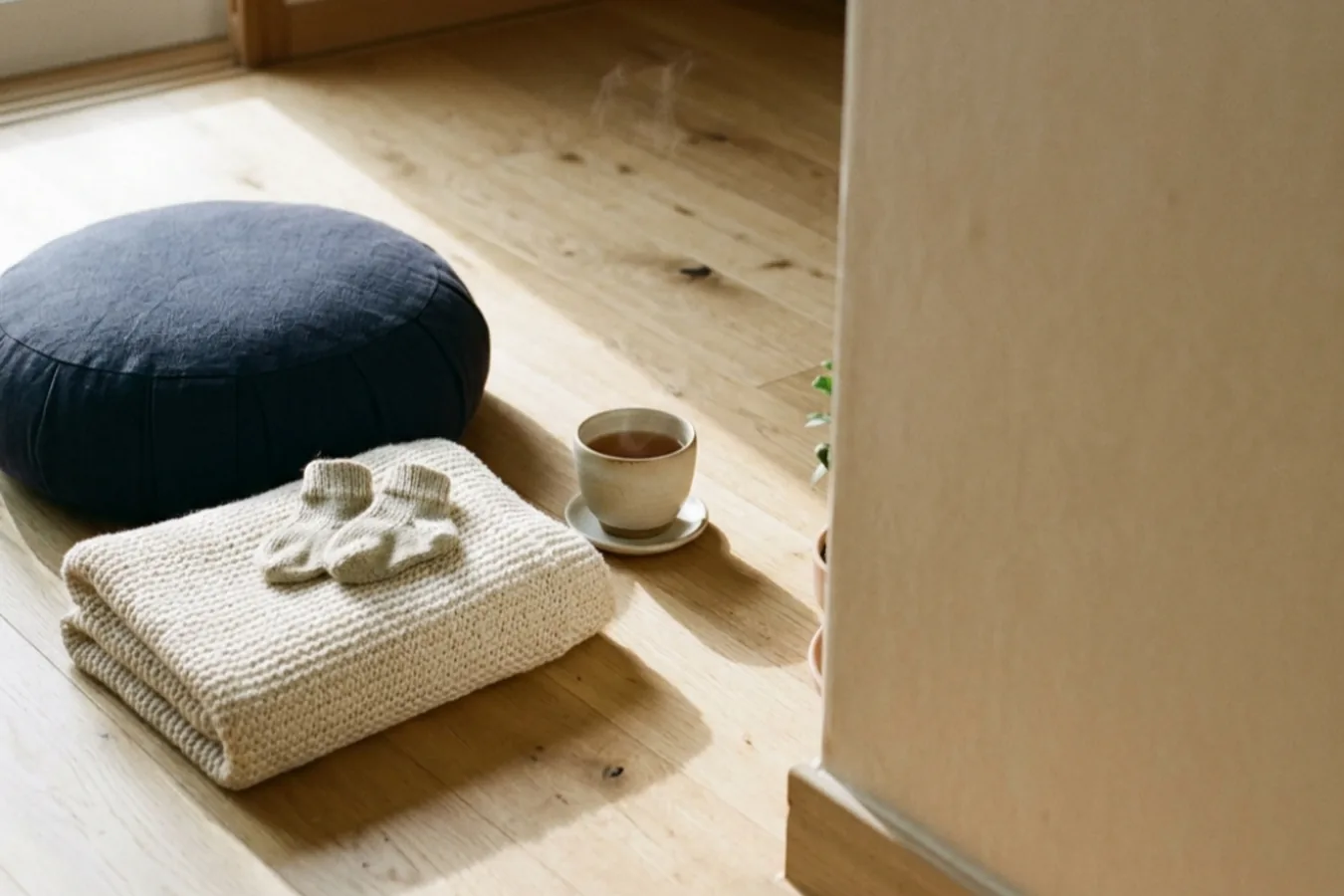
I only sat, and the energy came the same
I went back to practice with the person who first opened the path of meditation for me. It had been a long time. Because I'm pregnant, I didn't join the shaking practice. When the shaking part came, I stayed seated and practiced that way.
By everything I have taught, I should have felt less. I didn't. The sense of energy rising and of my body and head becoming clear was no different from a normal session. Even the feeling I remember from my very first years of practice, the sense of my soul answering, was there just as it used to be.
And one more thing happened. I sent the energy that filled me to the baby, and that time simply became prenatal care. I hadn't set aside separate time for it. The practice itself was the prenatal care.
In Korea there is an old tradition called taegyo, often translated as prenatal education: the idea that what a mother sees, hears and feels during pregnancy reaches the child. People usually picture it as classical music or picture books. For me it turned out to be simpler than that. It can be a few quiet minutes of sending what you have received to the one you're carrying.
Shaking is the fastest road, not the only one
Here is why I usually recommend the shaking practice. In the tradition I teach, we say a person has three bodies: the physical body, the mind or spirit, and an energy body that connects the two. Think of a computer. You can have the hardware and the software, but without electricity neither one does anything. When energy isn't moving, body and mind don't connect. If you shake the body quickly, its rhythm has no choice but to speed up, and that is why shaking is the quickest way to wake the energy up.
But there are two other things I say in class, and they turned out to matter more that day. The first is that energy goes where your mind goes, so what you call on, what you turn toward, shapes what you meet. The second is that while you move, you shouldn't judge. Thoughts like "why can't I do this" or "why does this hurt" are evaluations, not sensations. Stay with the sensation.
Shaking gets you to that place fast. How deep the practice goes is decided less by how hard you move and more by how open you are to receive. That day I confirmed it in my own body.
This isn't only about pregnancy. It's the same if you are recovering from a back or knee injury, if big movements have become hard with age, or simply on a day when you're coming down with something. When the movements get smaller, the practice doesn't have to.
When you can't move big: what to drop, what to keep
The rule is one sentence: make the movements smaller, but don't shorten the time you spend feeling. If you're pregnant, what your own doctor or midwife has cleared you for comes first. Within that, sort your practice like this.
What to drop:
- Vigorous whole-body shaking. Scale it down to gently shaking out the wrists and shoulders while seated, or rest.
- Tapping or striking the lower belly. Several Korean practices include rhythmic tapping on the danjeon, the energy center a few centimeters below the navel. Skip it, and instead rest your palms quietly on the lower belly.
- Holding the breath or bearing down. Breathe in comfortably and let the exhale be long. Holding your breath while straining raises pressure in the abdomen.
- Anything you could fall from. Do one-legged balances only next to a wall, and leave them out if you're unsure.
- Practice in heated rooms. Skip hot yoga and other classes held in deliberately hot rooms.
- Lying flat on your back for long stretches. After the first trimester, move lying-down relaxation or meditation to a seated position or to lying on your side.
What to keep:
- Sitting upright, comfortably
- Easy breathing with a long exhale
- Feeling energy with your hands (the jigam practice below)
- Quietly watching the thoughts and feelings that come up
The "keep" list alone is a full practice. What I received while sitting through the shaking was proof of that.
A seated prenatal meditation in eight steps
This sequence takes a stage of our regular practice called jigam and carries it through to sending energy to the baby. Jigam literally means "stopping the senses": you stop reaching outward with your attention and feel energy with your hands and body instead. A chair or floor cushion is all you need. In a full session this stage runs about twenty minutes, but ten minutes is a fine place to start.
- Sit. On a chair, place your feet shoulder-width apart and parallel, soles flat on the floor. Tilt your tailbone back and let your hips settle toward the back of the seat; your spine will stand up straight without you having to hold it with your lower back. Sit a little away from the backrest if you can, and lean back if that's more comfortable.
- Let go of effort. Release as much tension as you can from your shoulders, back and arms.
- Bring the hands together. Open your palms and hold them together in front of your chest, about ten centimeters away, as if in prayer. First notice the warmth of your palms and each fingertip.
- Open the space. Separate your palms by about five centimeters. Many people feel a push and pull between the hands, a faint tingling, or something soft and dense. Slowly widen the gap to ten, then twenty centimeters, and slowly bring it back in.
- Acknowledge it. However faint the sensation, tell yourself, "There it is." The sense wakes up and grows when you acknowledge it. If you feel nothing at all, that's fine too. Stay with the space between your hands.
- Receive. Soften your hands even more and move them through the air slowly, as if swimming underwater. Take in the energy filling the space around you, with gratitude.
- Send it to the baby. Slowly bring both hands in front of your lower belly. Don't press. Rest your palms there lightly, or let them hover just above. Then call your baby. If you have a nickname for the baby, use it. Imagine the warmth gathered in your hands flowing to the child. Energy goes where your mind goes.
- Close. Breathe comfortably down into your lower belly and exhale slowly, two or three times, without holding the breath. Rest your hands on your knees and open your eyes.
A scene that came to me that day
In the middle of that session a picture came to me. The child who will be born someday was running into the arms of my teacher, who stood in light, and I was beside them, watching and smiling. Gratitude and love rose up all at once, and I cried.
Practice can feel like a road you walk alone. That day I saw that it isn't. There was the person who first woke me up, and what I received from that bond was already flowing on to the next generation. That is how I see prenatal meditation now. Before it is a time for telling the baby anything, it's a time for passing on the energy and love you have been given.
When to stop
Emotions or tears during meditation are fine. Body signals are a different matter. If you feel dizzy or short of breath, if your belly tightens or hurts, or if you notice bleeding or anything else unusual, stop right away and talk to your doctor or midwife.
I wrote about what solo practice and group practice each give you in Meditating Alone vs. in a Group. For breathing into the lower belly, see How to Do Dantian Breathing; if you're pregnant, leave out the belly tapping in that post and practice only the part where the belly follows the breath. If nausea is the hard part of your days right now, Morning Sickness and Hunger Nausea may help. And if you'd like a voice to guide you, you can follow the meditation videos on WECOSMO.
A season of smaller movements comes to everyone at some point. If you can still sit, the practice goes on.
Services by Botonglee