Korea Clothing Label Requirements
On the quotes I write for clothing production, the trims section has two separate lines: main label and care label. The main label carries the brand name. The care label says what the garment is made of and how to wash it. New brands tend to spend their attention on the first one, but the content of the second is not a design decision. Korea has a written standard for it.
I have designed clothing and managed production in Korea for 15 years, and if you are a small brand producing here, importing finished goods, or selling into the Korean market, this is the checklist I would hand you. I checked the items below on November 9, 2026 against the original text of the Korean Agency for Technology and Standards (KATS) safety standard for household textile products. The latest version I could find is the one issued in March 2024.
This matters more in winter. In January 2026 Korea's Fair Trade Commission sanctioned 17 online clothing sellers for false or exaggerated claims about down fill and cashmere content.
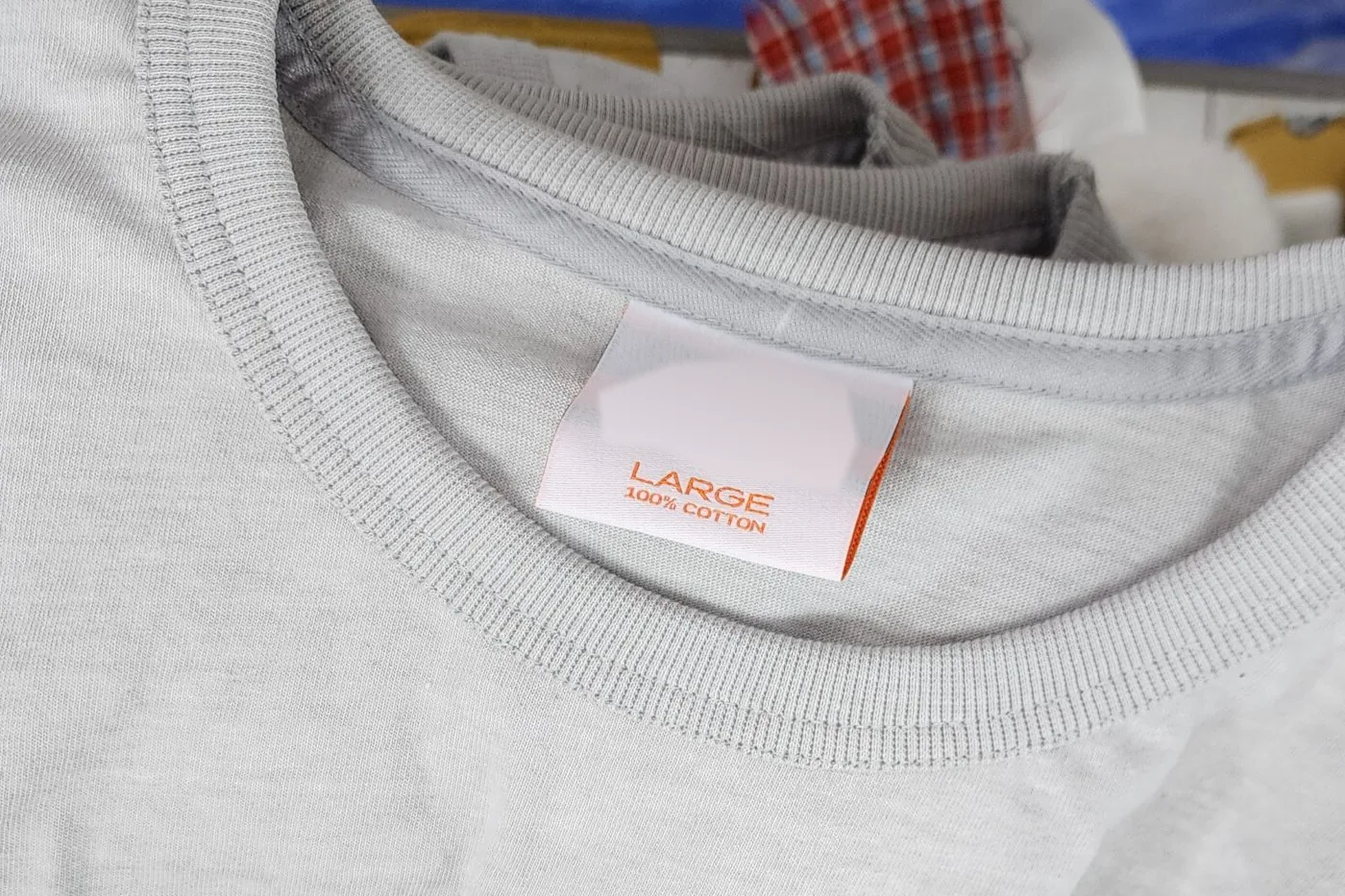
Does this apply to a small run?
Clothing for people aged 14 and over falls under the household textile standard, and the standard contains no minimum-quantity exemption. What it excludes is children's clothing, which has its own rules, and custom-made garments, defined as clothing individually ordered for one person with the shape, materials and colors chosen for them. Twenty identical pieces made for sale are not custom-made.
Whether uniforms given away rather than sold are covered is not spelled out in the standard. If it matters for your project, ask KATS. Either way, the wearer still needs the fiber and washing information, so I would label them.
One piece of good news: for this category there is no mandatory product test and no KC mark. You are not required to obtain a test report, but the limits on harmful substances such as formaldehyde and pH still apply to you, and the labeling rules are compulsory.
The six required items
- 1. Fiber composition for the shell, the lining, and the fill if there is one
- 2. Name of the manufacturer or importer
- 3. Country of manufacture
- 4. Something that traces when it was made: manufacturing date, first sales season, lot number, style number, barcode or QR code (any one of these)
- 5. Care instructions
- 6. Address and phone number of the party responsible for the label
Size is recommended rather than required.
The method is specified too. The information must be attached by stitching, or something equally durable, so that it does not fall off or fade through washing or dry cleaning, and it must be in Korean. Only items that are hard to render in Korean, such as a manufacturer or model name, may stay in English. An English-only care label on a garment sold here does not meet the rule.
Some products may use packaging, a hangtag or a sticker instead of a sewn label: undershirts, underwear, socks, gloves, swimwear, gym wear, scarves, mufflers, hats, ties and reversible garments, among others. An ordinary T-shirt, pair of trousers or coat is not on that list, so a hangtag alone is not enough.
The responsible party in line six is whoever answers for defects and recalls. The standard allows this to appear as a product contact, consumer service desk, manufacturer, importer or seller. If a factory sews your clothes and you sell them under your brand, put the contact that will actually answer your customers.
For a pair of jeans, a care label would look roughly like this. The names and numbers are examples.
- Shell — 면 97%, 폴리우레탄 3% (cotton 97%, polyurethane 3%)
- Manufacturer — your company name
- Country of manufacture — 한국산 (made in Korea)
- Style number — DP-2611-01
- Care — symbols for water wash, bleach, ironing and dry cleaning
- Contact — company name, address, phone number
Writing fiber content the way the label requires
On a jeans work order I used for years, the fabric is written as cotton 97%, "span" 3%. That is fine between you and a factory. The label has to use the standard's unified fiber name, and for span that name is polyurethane. If you want to mention spandex as well, it goes in brackets after the official name.
- Whole numbers only. Cotton 95%, polyurethane 5% is correct. Cotton 95.5%, polyurethane 4.5% is given in the standard as an example of a wrong label. Round at the first decimal place
- You may break it down by part. Shell and lining are listed separately, and if the body and sleeves use different fabrics you can list each
- Fibers under 5% can be grouped as "other", although naming them is recommended
- There are tolerances. A label reading 100% allows a shortfall of 1%, or 3% for wool. A percentage written in multiples of five allows ±5, and any other figure allows ±4
- Tolerance is not a loophole. A fiber you added on purpose has to be listed even if the amount falls within the tolerance
Confirm the blend when you buy the fabric, write it on the work order, and carry that number through to the label. If the fabric changes, the care label changes with it. For anything that drives the price, such as cashmere or down, do not rely on a figure someone told you. Get a test report. Some online platforms in Korea now require down test reports from the brands they carry.
Country of origin and label swapping
The country of manufacture is the country of the manufacturer. Where several manufacturers are involved, it is the country of the one who gave the product its function. Goods made in Korea are marked so that a consumer can tell, for example 한국산. Imported goods follow Korea's Foreign Trade Act.
Sewing your brand label into a garment made abroad is one thing. Replacing its origin label is another. A joint government crackdown from February 9 to May 19, 2026 caught 193 companies with origin-marking violations worth 41.6 billion won. The cases included wholesalers having sewing shops replace foreign origin labels with Korean ones and selling the clothes as domestic, and origin labels being removed so that goods circulated with no origin marking at all. Penalty surcharges under the Foreign Trade Act run up to 300 million won.
If you add your brand label to finished imports, leave the origin marking as it is. If cutting and sewing cross borders, ask customs or a licensed customs broker before you decide what the label says.
Care symbols: at least four
Care instructions must cover at least four kinds of treatment, including water washing or dry cleaning, using the symbols in Korean standard KS K 0021 or written Korean. A garment with metal accessories also needs warnings that washing may cause rust and that skin allergies may occur depending on the wearer.
The standard says the instructions must suit the product. When your sample arrives, wash it once exactly as the label will say. Check whether it shrinks, bleeds or cracks at the print. It is the cheapest test you can run yourself.
Down jackets
A product can be called a down product only if its entire fill meets the down quality standard in KS K 2620. Fill content has to be broken out as percentages of down, feather and other fiber. If different parts of the garment use different fill, each is listed separately, and recycled feathers must be declared with a specific phrase. The standard gives this example:
- Shell — nylon 100%
- Lining — polyester 100%
- Fill — goose down 80%, goose feather 20%
As reported when the Fair Trade Commission acted in January, goose down requires at least 80% goose and at least 75% down. In a December 2025 Korea Consumer Agency test of 24 products sold as goose down, five had goose content of only 6.6% to 57.1%, and two listed online as goose were actually duck.
I have produced duck down jackets for a womenswear brand, where the fabric, trims and labels were each confirmed one by one. If you make down outerwear, keep a test report for the fill and match the label and product page to it.
Children's clothing needs more than a label
Clothing for children aged 13 and under falls under Korea's children's product rules. Textile products for infants under 36 months must be tested by a testing body, reported and then given a KC mark. Textile products for children from 36 months through age 13 must be tested by model before shipment to confirm they meet the safety standard, either in-house or through a third party, and then carry a KC mark. Without the mark they cannot be sold.
I have worked on hundreds of children's designs over more than five years. If children's wear is your plan, put the testing schedule and cost in your budget before you finalize designs. Exemptions exist, so ask a testing body early if you think one applies.
Write the label position on the work order
Here is part of a work order I used for a pair of trousers, with the brand logos blurred.
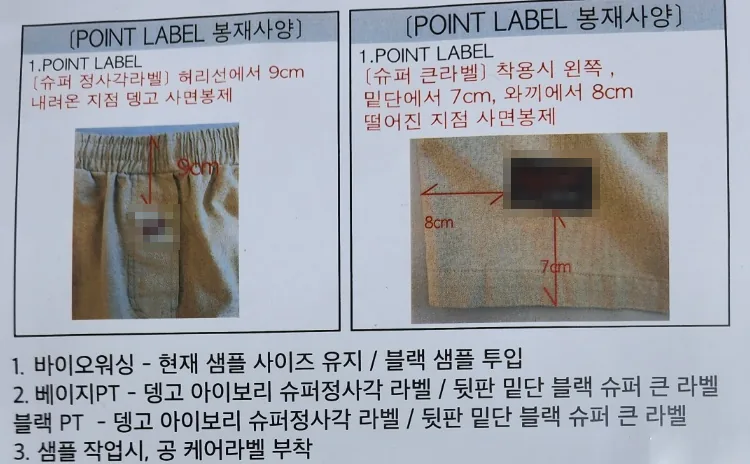
One label sits 9 cm below the waistline. The other is on the wearer's left, 7 cm from the hem and 8 cm from the side seam, stitched on all four edges. Leave that out and the placement is the factory's guess.
The last line reads, in Korean, that a blank care label should be attached at the sample stage. You can set the position on the sample before the final content is settled.
Small labels are easier to judge on the garment itself, so I pin them on and move them around.
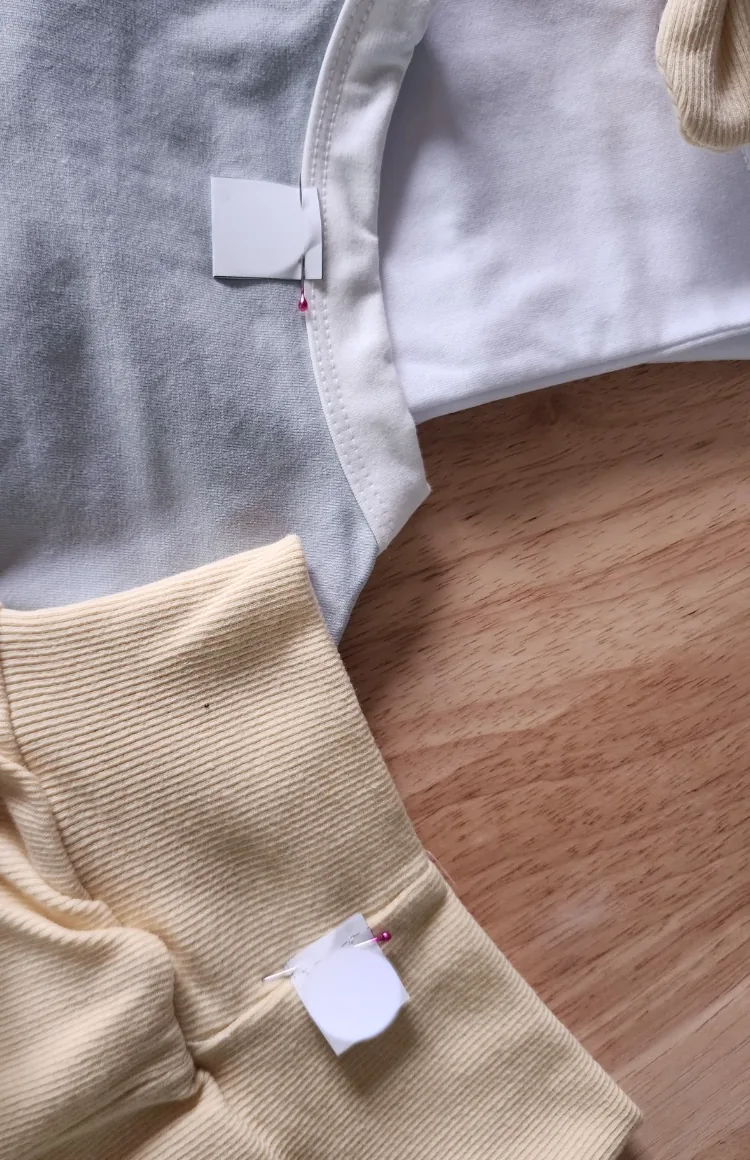
Order labels at the sample stage
Labels take one to two weeks to make, so order them with your sample or your production date will slip. At my shop, labels start at 1,000 pieces, 100 to 350 won each, and hangtags start at 500 pieces, 150 to 300 won each. I wrote more about first-run costs and timing in what a small-batch apparel sample really costs in Korea, and the trims line sits on the work order described in how to write a garment work order.
A main label keeps working when the style changes, but a care label needs to change if the fiber or washing instructions change. If you use style numbers for the traceability line, every style needs its own label. If you use the manufacturing date or first sales season, styles that share a fabric can share one care label. Either way, you must still be able to trace when a garment was made, so keep records.
If you sell online
Online sellers in Korea must give information such as material, country of manufacture and manufacturer on the product page before purchase. One online shop drew a Fair Trade Commission decision for listing material and size while leaving out the country and date of manufacture. If the label and the page disagree, one of them is wrong as far as the customer is concerned.
Keep one sheet per style with the fiber content, origin and care, and copy from it to both the label and the page.
Seven checks before you order labels
- How old is the wearer? For age 13 and under, testing and a KC mark apply
- Is fiber content in whole numbers and official fiber names, for shell, lining and fill?
- Do the manufacturer and country match where it was actually made?
- Is there one traceability item: date, season, lot, style number, barcode or QR code?
- Are there at least four care treatments, plus the warnings if there is metal hardware?
- Do the address and phone number reach whoever really handles customer questions?
- Is it attached so that it survives washing, and is it in Korean? Does the product page say the same thing?
These are the rules as I checked them on November 9, 2026, and they can change. Before you sell, confirm anything uncertain with KATS or a testing laboratory.
I can make your labels and hangtags along with the garments. Tell me what you want to make and how many, and I will send a quote with the trims broken out.
Services by Botonglee