Clothing Sample Lead Times Over the Holidays: Count Back From the Day You Need the Goods
Most of the clothing inquiries I get at this time of year come with a date attached. "I'd like the sample in late December or early January, and the finished pieces made and delivered in January." "This is a grant-funded prototype, so I need to receive it and get it approved by December 31."
I move as fast as I can. But there are two things I tell everyone who writes in now. Christmas and the turn of the year squeeze the schedule, so leave yourself room. And decisions need to come quickly. Even when everyone moves fast, this season does not always go the way you plan.
Below are the basic lead times for making clothes, laid over this winter's calendar in Korea, and a way to count back from the day you actually need the goods. It is written for anyone planning a spring launch, ordering uniforms for early next year, or working to a year-end deadline.
The baseline: about two weeks for a sample, two to three for production
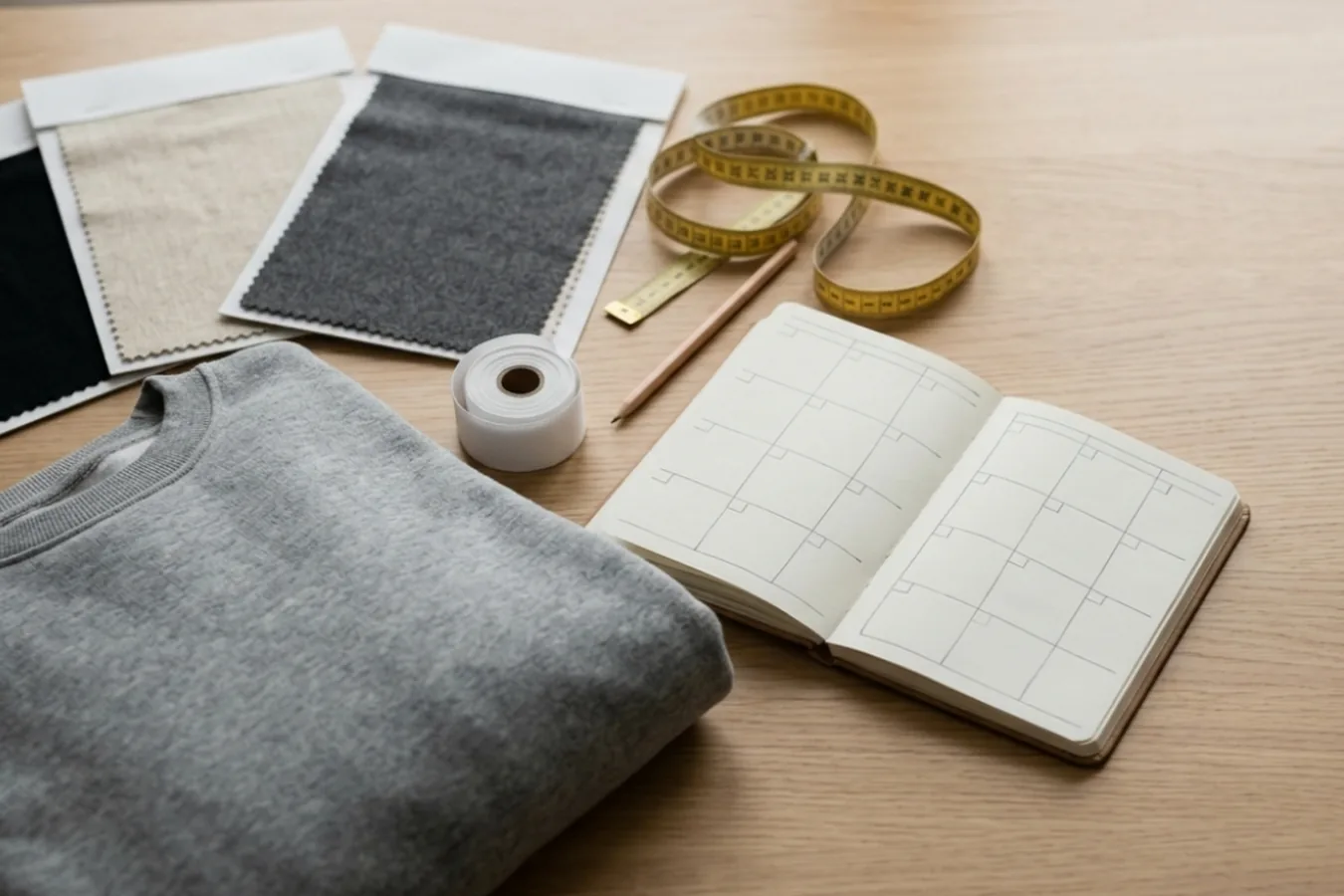
When I make a garment from scratch, the first sample takes about two weeks on average, and the main production run takes about two to three weeks. Both can stretch depending on how quickly fabric and trims arrive and how busy the factories are.
Three more pieces of time attach to that baseline.
- Choosing the fabric. You choose fabric by touching real fabric swatches, not by looking at photos. I send swatches once the sample fee is paid, so the time you spend choosing sits in front of the sample.
- Checking and correcting the sample. This is the time to try the sample on and decide what to change. If the change is clear, it goes straight into production. If you need to see it again in person, I make a revised sample, and that adds two weeks or more.
- Labels. Brand labels are made separately from the clothes. More on that below.
Mark this winter's holidays first
Between December and February there are three breaks on the Korean calendar.
- Christmas — Friday, December 25, 2026.
- New Year's Day — Friday, January 1, 2027.
- Lunar New Year (Seollal) — Saturday, February 6 to Tuesday, February 9, 2027. Seollal itself falls on a Sunday this time, so Tuesday the 9th is a substitute holiday.
If you are outside Korea, the last one is the easiest to miss. Seollal moves with the lunar calendar, and it is one of the two biggest holidays of the year here.
Put two weeks of sampling and two to three weeks of production on that calendar and almost any job that starts in December runs through at least one holiday. So mark the holidays before you count, and leave room on either side of them.
Count back from the day you need the goods
Start the calculation from the day you need the goods, not the day you start. Here are two cases. Both assume the smoothest possible run: the fabric is chosen right away and no revised sample is needed.
If you need the goods before Seollal
- The last weekday before the holiday is Friday, February 5.
- Take away two to three weeks of production, and production has to start by mid-January at the latest.
- The sample has to be approved before that. Take away two weeks for the sample, allow for Christmas and New Year's Day in between, and the sample needs to start by mid-December.
- To start the sample, the fabric has to be chosen, which puts fabric selection in early December.
Seen from the end of November, that means fabric and labels need to be settled within two to three weeks. One revised sample pushes everything back two weeks or more, and delivery lands after Seollal. If you had "sample in late December, delivery in January" in mind, run your own dates through this count once.
If you want the goods by late February to sell in March
- Start production in early February, and it finishes in the second half of February, after the four days of Seollal.
- That leaves January for the sample and for checking it. There is room for one revised sample.
- The labels need to be there when production starts, so ordering them in December is the safe choice here too.
Either way, the common thread is the same. More has to be decided in December than most people expect.
Four places a holiday schedule slips
1. Labels
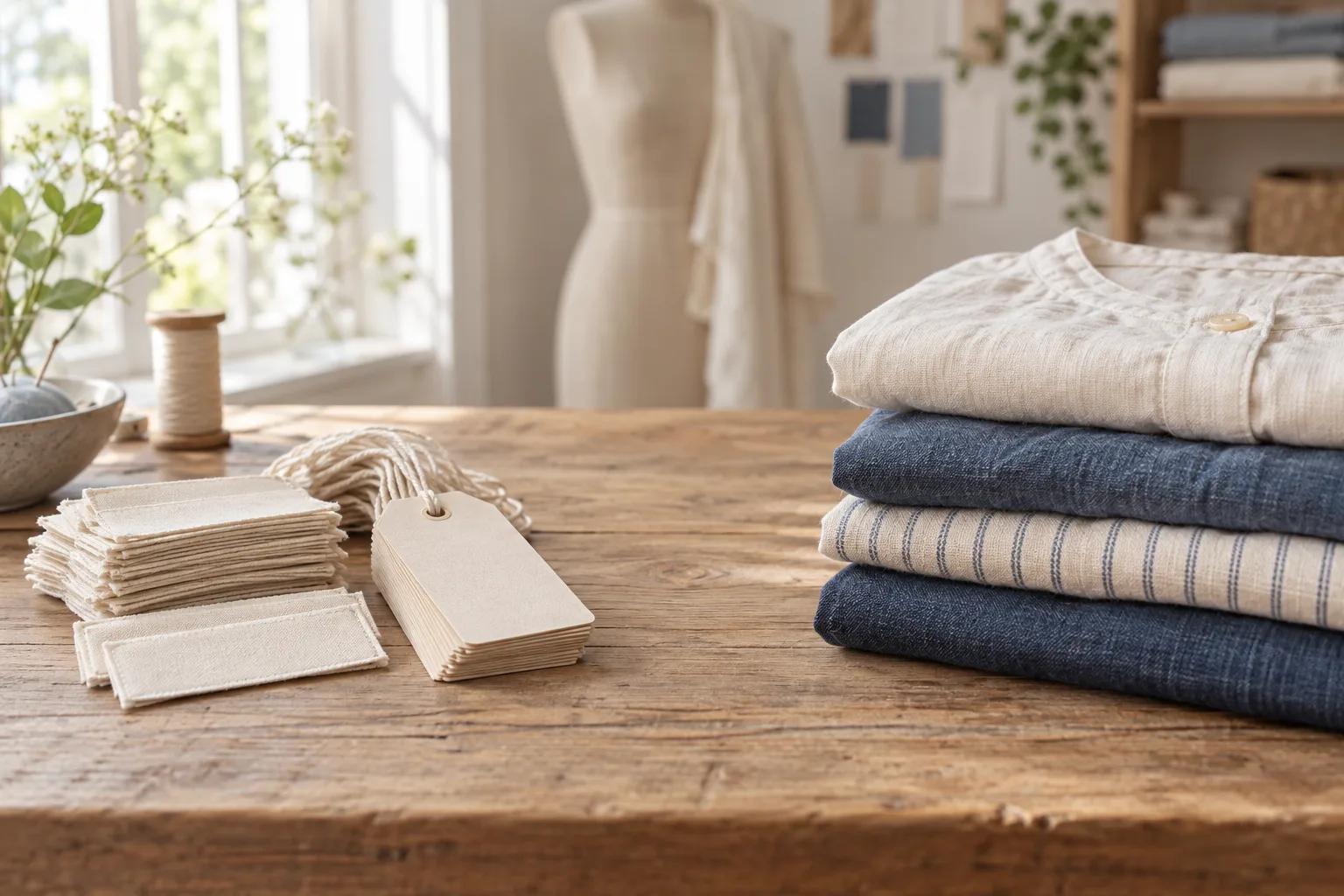
The brand label at the back of the neck is made separately from the garment. My FAQ gives one to two weeks for labels. But when people asked about January production with the holidays in between, my answer was to allow about a month and order in December to be in time for a January run. The minimum order for labels is 1,000.
When labels are late, the clothes are finished and then sit waiting. That is why I order labels at the same time the sample starts. Care labels — the fiber content, care symbols and country of origin inside the garment — are a separate requirement, covered in what Korean law requires on a clothing label.
2. Revised samples
A sample exists to be corrected, so it is normal to find something you want to change. The problem in this season is that one revised sample takes two weeks or more, and a holiday can fall inside those two weeks.
The way to need fewer revisions happens before the sample is made. Describing fabric and fit in words or photos is slower than sending one similar garment and telling me what to change. It saves the most time and money, because it gives us a shared reference: "a little thicker than this," "a dropped shoulder like this one." When the sample arrives, send all your changes together in one message.
How many sample rounds a garment tends to need depends on the garment; I wrote about that in how many sample rounds to expect for petite and plus-size clothing.
3. Choosing the fabric yourself
You can leave the fabric to the designer, or see and choose it yourself. If you leave it to me, finding and choosing the fabric is included in the sample fee. If you choose it yourself, there is one more step — finding and sourcing what you picked — and the schedule grows by that much. If you buy the fabric yourself and bring it, the fabric cost comes off the quote.
Choosing it yourself is not the wrong call. But if you go that way in this season, keep time free on the day the swatches arrive so you can look and reply the same day.
4. Adding styles midway
Styles sometimes get added while sampling is under way. Someone asks about five pieces, starts with three, and plans to send two more once they are sorted out. If you have styles to add, send them as early as you can. Each style needs its own fabric search and its own pattern, so a style added late rarely finishes on the same day as the ones that started first.
A grant-funded prototype due by December 31
If you are making a prototype with grant or agency funding, your deadline is fixed. One inquiry this year came with exactly this condition: the product had to be received and approved by the agency by December 31. A quote, an electronic tax invoice and a copy of the business registration certificate were needed as well.
My answer to that inquiry was this. When the design is complex and the quantity is small, the timeline is tight, and it only works if feedback and decisions come very quickly.
The arithmetic shows why. Even starting at the end of November, there are only about five weeks until December 31. If the prototype is a single sample, two weeks or so can fit. If it means producing several pieces, another two to three weeks of production gets added, and that uses up nearly all five weeks. Christmas sits in the middle, and the agency's approval needs its own days at the end. There is almost no room for a revised sample.
So in your first message, tell me three things, and we can judge quickly whether the date is realistic:
- Whether the deadline is the day you receive the product, or the day the agency finishes approving it.
- Which documents the agency needs, and by when.
- Whether the design is already decided, or needs to start from the design stage.
What to settle in December
- The date you need the goods — and whether it can move. If it is an event or a launch date that cannot move, say so at the start.
- Styles — if you plan to add any, now.
- Fabric — leave it to the designer, or choose it yourself. If you choose, keep the swatch arrival day free.
- Labels — artwork and quantity, ordered together with the sample.
- Who checks the sample, and when — who will try it on and reply when it arrives, and whether that clashes with year-end time off.
When you get in touch
If your first message includes the date you need the goods, the styles and rough quantities, a reference garment or photos, and whether you need labels, I can lay out the options and a rough schedule first. I work in Seoul and ship finished orders to other parts of Korea by courier and overseas by air or sea freight.
What a sample fee actually pays for is in why small-batch clothing samples cost what they do, and how to write specs a factory will not need to ask about again is in how to write a garment work order.
Request a clothing production quote · More answers are in the clothing production FAQ.
Services by Botonglee