Korean Wedding Group Photos (Wonpan): How to Plan the Order and the List Before Time Runs Out
When a Korean wedding ceremony ends, nobody leaves the stage right away. Family, relatives and friends are called up in turns to stand with the couple for formal group photos. Koreans call these wonpan. They open the wedding album, and years later they are often the photos parents take out more than the couple does.
They are also the most rushed part of the day. Many Korean weddings are held in wedding halls that run ceremonies back to back, and the group photos have to be finished before the hall is reset for the next couple. If you are planning a wedding in Korea, or flying in for one with family from abroad, that single fact shapes everything below: decide how many groups you can fit and who will gather each family before you start writing names.
I photograph wedding ceremonies in Seoul, and a week before each wedding I send the couple an information form with a separate section just for the group photos. This post walks through what that section asks and why. It works the same whatever hall or photographer you choose.
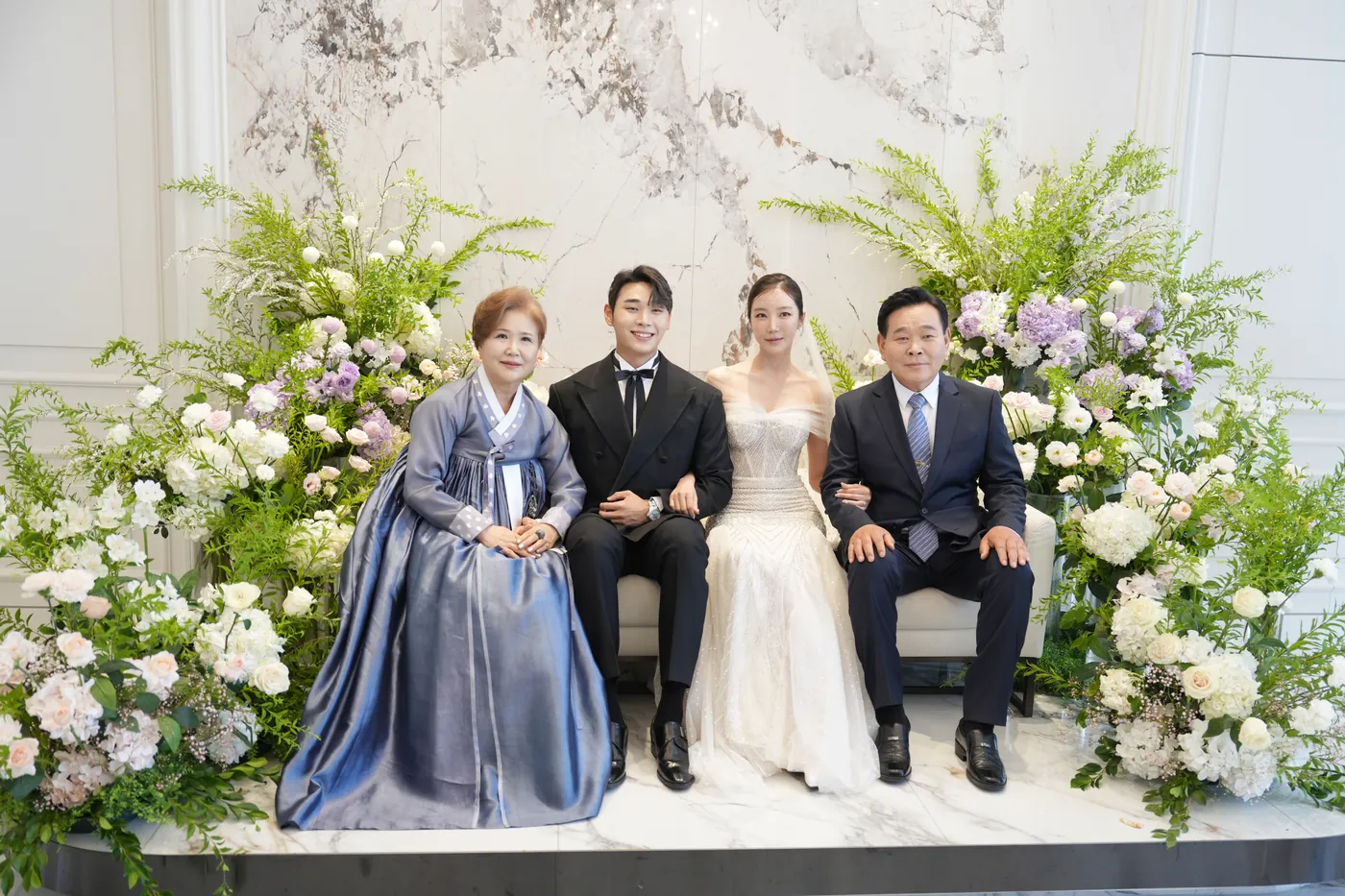
Why the group photo window is always short
The group photos are taken on the spot, right after the ceremony. Guests begin heading to the banquet, and the hall staff need the room for the next wedding. When the hall asks you to wrap up, you wrap up, even if groups are still waiting.
My own booking terms list "missed shots and a shortened group photo session because the venue stops the shoot to prepare the next ceremony" among the things a photographer cannot control. Neither the couple nor the photographer can make that window longer.
What you can shrink is everything around the shutter. Taking the picture takes about the same time no matter what; finding people, calling them up and lining them up is where the minutes go, and that part depends almost entirely on preparation. Each step below is a way to cut it.
1. Ask the wedding hall two questions first
Before you write a single name, get answers to these from the hall coordinator or your wedding planner.
- "How many minutes do we have for group photos after the ceremony?" It depends on the gap between ceremonies, so it varies by hall and even by time slot in the same hall. You need this number to decide how many groups you can have.
- "Does the hall's own photographer take the group photos?" Some halls have their own in-house photographer, and where they do, that photographer may get the center spot for the group shots. Your own photographer then works from the side, and the person calling out the groups is the hall's photographer. In that case, send the same list to both so nobody is working from a different order.
My form asks for exactly these: the planned start time of the group photos, how long you have, the gap between ceremonies, and whether the hall has its own photographer. They are all answers only the hall can give you.
2. Work backwards from the time to the number of groups
Once you know the time, fit the groups to it. Say you have 20 minutes and ten groups. That gives each group two minutes to walk up, line up, be photographed and step off. With fifteen groups, it drops to one minute and twenty seconds.
Not every group takes the same time, either. The bigger the group, the longer it takes to arrange, and the rarer the frame where everyone has their eyes open and is looking at the camera, so more frames are needed. That is why it helps to tell your photographer how many people are in your largest group along with the number of groups. They can plan where to stand and how to frame it ahead of time.
If you have more groups than time, trim like this:
- Merge similar groups. Instead of the mother's side and the father's side of the bride's family going up separately, make one group: the bride's relatives.
- Move photos that don't need to be wonpan. A relaxed photo with your parents, or with a few close friends, can be taken in the bridal room before the ceremony (step 6).
- Build each family's photos by adding people. That's the next section.
3. Four principles for the order
There is no single correct order, and halls run the session a little differently. But when time is tight, these four rules prevent most problems.
First, put the photos you can't lose at the front. If time runs out, groups drop off from the end. The couple with both sets of parents is the photo nobody wants to miss, so it goes first.
Second, within each family, add people rather than starting over. Parents, then siblings and their families, then all the relatives. People already standing stay in place and only the newcomers walk up, which is much faster than clearing the stage and arranging everyone again for every shot.
Third, put elderly relatives and anyone with limited mobility near the front. Those who find it hard to stand and wait can be photographed early and then rest. If a family member uses a wheelchair, tell your photographer in advance so their position can be set first. My form has a separate line for this.
Fourth, put the largest group last. Friends and coworkers are usually the biggest groups. They take the longest to gather and the longest to get a frame with everyone's eyes open. At the end of the list, even if things run late, the family photos are already done. If a friend has been chosen to catch the bouquet, note that next to this group.
Which family goes first is something the two families should agree on beforehand. Deciding it on the spot costs exactly the minutes you don't have.
4. Write the list as groups, not names
A list of fifty names is hard to use on the day, because whoever runs the session doesn't know who those people are. Instead, write one line per group: a number, who stands in it, and roughly how many people. For example:
- The couple alone, 2 people
- The couple with both sets of parents, 6 people
- Bride's side: parents, older sister, her husband and their child, 7 people
- Bride's side: group 3 plus aunts' and uncles' families, about 20 people
- Groom's side: parents and older brother, 5 people
- Groom's side: group 5 plus aunts' and uncles' families, about 18 people
- Both families together, about 35 people
- Groom's coworkers, about 12 people
- Friends of the couple, about 25 people, with the bride's friend catching the bouquet
That's nine groups. If your window is short, keep only one of groups 3 and 4 and one of groups 5 and 6.
If there is a group photo you really want, such as a grandmother with the couple, a former teacher, or a club you belong to, don't tack it onto the bottom. Slot it into the place where it belongs. Whatever sits at the bottom is the first thing lost when time runs out.
Send one version of the list to the hall, your photographer and both family helpers. If you change it, resend it to all of them. People holding different lists will spend the session reconciling them.
For international families, it helps to add a short description next to names that the hall staff and photographer won't recognize, such as "the bride's aunt, wearing a navy dress." The helpers in the next step do the rest.
5. Pick one helper from each family
My day-of guide for couples includes this line: "The group photos have to finish before the next ceremony is prepared, so the faster each family's helper gathers relatives, the more time we have for the photos."
A photographer has no idea who your aunt or your cousin is. A list only works when someone from each family can recognize people and call them up. Choose that person like this:
- Someone who knows the whole family by sight. A cousin or an aunt who is close to both older and younger relatives is ideal.
- Someone with no other job during the photos. The couple and the parents need to be in the pictures, so they can't run the session. Avoid anyone who has to stay at a post after the ceremony, such as whoever is handling the gift money table.
- Someone who has the list in hand. Saved on their phone or printed out, so they can line up the next group while the current one is being photographed.
Give your photographer the two helpers' names and phone numbers too. If the order changes or someone can't be found, it can be sorted out immediately. It also helps to ask the emcee to announce near the end of the ceremony that family members should stay for the group photos.
6. Take photos with your parents in the bridal room first
Wonpan are record photos, everyone facing forward, on a fixed clock. The relaxed kind of family photo, a mother and daughter sitting side by side and laughing, rarely fits into that window.
In a wedding I shared as a portfolio, we took the family photos in the bridal room before the ceremony, because the wonpan alone after the ceremony isn't enough.
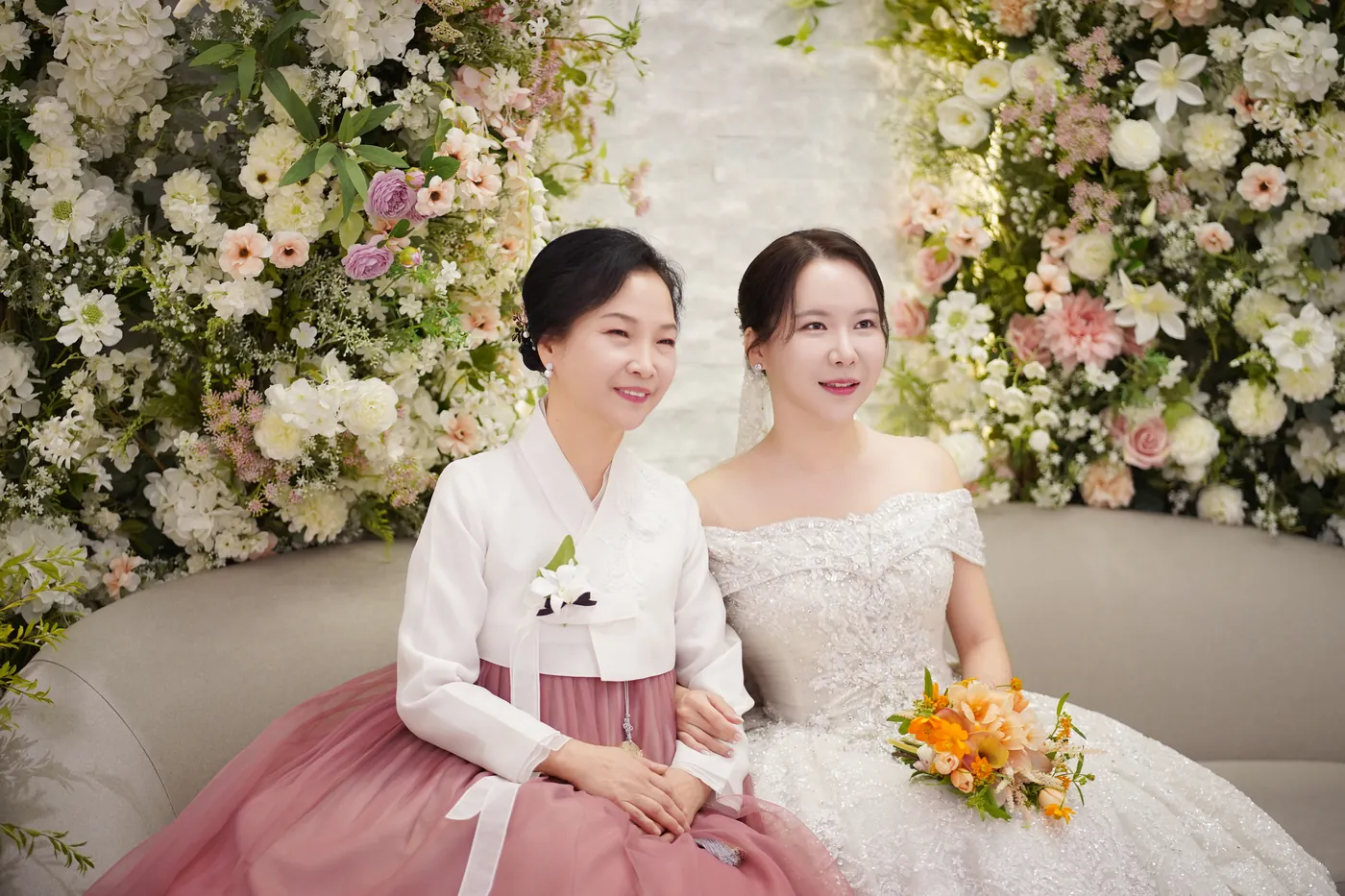
Two things make this happen. Tell your photographer when you will arrive in the bridal room, and ask your parents ahead of time to stop by the bridal room for a few minutes before the ceremony. At a Korean wedding, the parents spend the time before the ceremony greeting guests at the entrance, so unless you ask in advance, they rarely find a moment.
7. When the group photos arrive
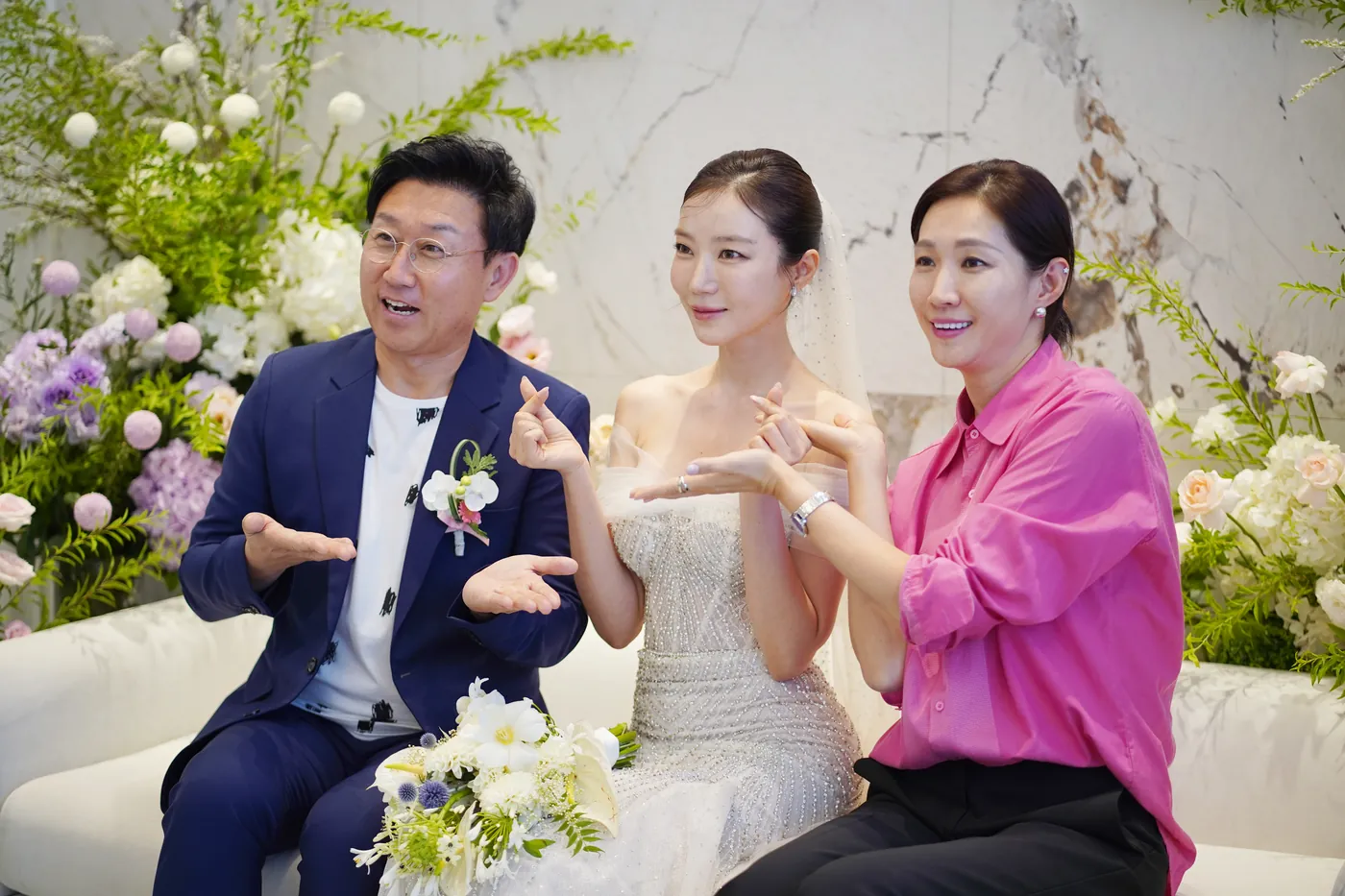
The bigger the group, the rarer the frame where everyone has their eyes open, so several frames are taken for each group. When you choose, start by looking for the frame where the couple and both sets of parents all have their eyes open. I've written up how to pick which photos to have retouched in which wedding photos to send for retouching.
If you would like me to photograph your ceremony
My standard coverage is the ceremony including the bridal room, through the end of the group photos, with one photographer. I arrive 1 hour 30 minutes before the ceremony starts and stay until the group photos finish, which is three hours as standard.
The information form I ask for seven days before the wedding includes these group photo questions:
- When the group photos start and how much time you have
- The order of groups, the number of groups and the size of the largest group
- Any group photo that must be included
- Whether any family member has limited mobility
- The name and phone number of one helper from each family
I plan the day's movements and shooting order from those answers, so if you prepare along the lines above, filling in the form is just copying it over.
The rate is 70,000 won per hour. The standard three hours come to 210,000 won, plus the round trip to your wedding hall, counted as at least two hours, so ceremony coverage starts at 350,000 won. If the ceremony runs past three hours, extra time is billed in 30-minute units of 35,000 won. You receive all original photos first and then choose how many to have retouched, at 7,000 won per photo. If you already have a main photographer, you can also book me as a second shooter.
The full timeline from inquiry to final photos is in booking a wedding photographer in Korea, and what a second photographer adds is in one photographer or two. All rates and cancellation rules are public on the studio page and in the booking and refund terms.
Booking information
Wedding ceremony photography inquiries
Looking for a female photographer for your ceremony, or a second shooter alongside your main photographer? Send me the wedding hall and the date, and I will confirm availability right away.
In short
- Wonpan must finish before the hall resets for the next ceremony, so the window can't grow. What you can shrink is the time spent gathering people.
- Before writing names, ask the hall how many minutes you have and whether their own photographer runs the group shots.
- Decide the number of groups backwards from the time, and tell your photographer the size of the largest group.
- Order: must-have photos first, add people instead of starting over, elderly relatives early, largest group last.
- Write the list as number, who, how many, and send the same version to everyone.
- Pick one helper from each family, and take relaxed photos with your parents in the bridal room first.
Services by Botonglee